On September 24th 2026, The Dialogue Society hosted the second installment in the Building Community Trust panel series- Community Trust Co-building with Migrants and Refugees. Against a backdrop of increasingly polarised national debate and hostile public narratives around migration this panel aimed to examine how trust is built, challenged and sustained through the lived experiences of migrants and refugees, and through their relationships with wider communities, civil society, and public institutions.
This event brought together a diverse audience of students, academics, community representatives, charity workers, and local government representatives who engaged thoughtfully and energetically with the presentations. Thank you to our panel and audience members for bringing their insight, perspectives, and energy to this discussion.
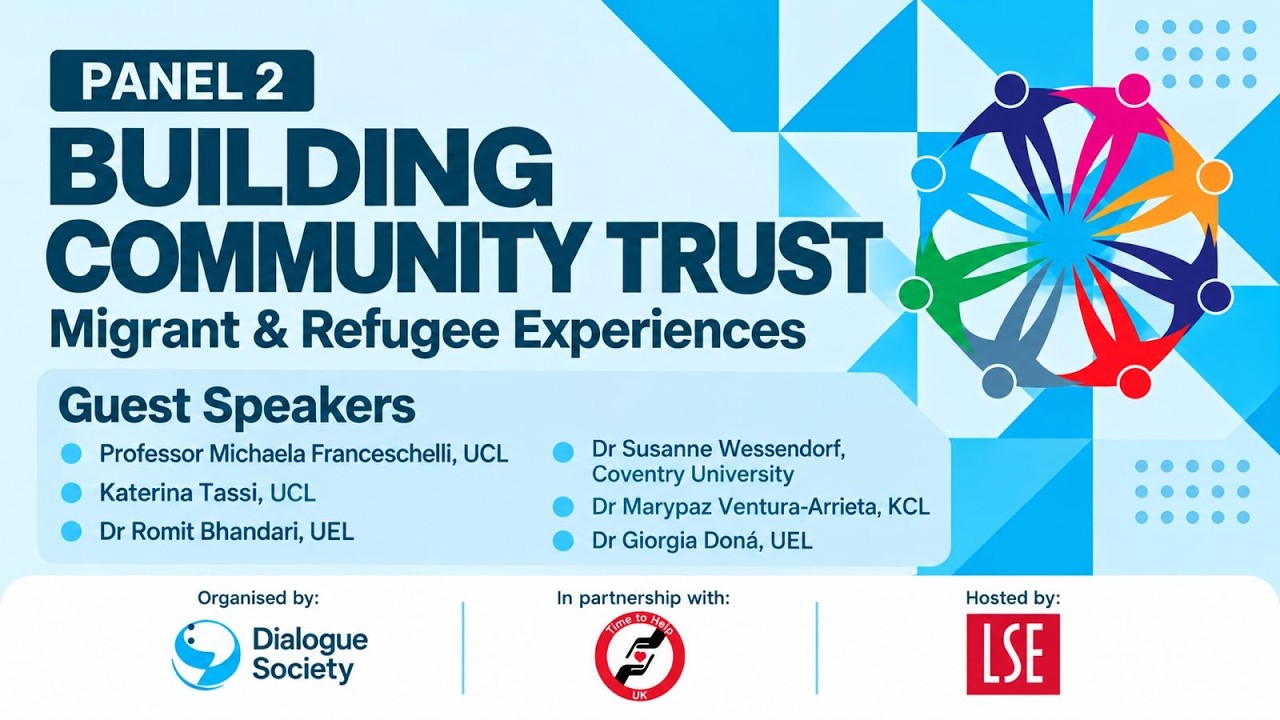
Guest Speakers and Presentations:
Dr Michaela Franceschelli and Katerina Tassi, University College London
Dr Franceschelli and Katerina Tassi shared findings of their joint exploratory study examining how migrant support is organised through networks of solidarity in East London. Their findings highlighted the crucial role of grassroots civil society organisations in fostering belonging, safety, and social connection for migrants, while also acknowledging the constraints these actors face within increasingly under-resourced systems of support. Ultimately, their presentation argues that trust-building is not simply an interpersonal process but is shaped by broader institutional and policy contexts.
Dr Susanne Wessendorf, Coventry University
Dr Susanne Wessendorf’s presentation added to Dr Franceschelli and Katerina Tassi’s findings by providing detailed insight into the everyday encounters within networks of migrant solidarity within the same context of East London. Dr Wessendorf confirms the trust building potential of narratives of inclusion that exist in East London, yet she also problematises such blanket statements by acknowledging how local narratives of inclusion can obscure the unequal realities that migrants and refugees encounter as a result of insecure legal status, restricted welfare entitlements, and language barriers. She argues that trust cannot be understood solely as a product of everyday contact as it is shaped by broader structures of inequality that condition people’s ability to participate, belong, and access support. This recognition is required for more meaningful and sustainable forms of inclusion moving forward.
Dr Giorgia Dona, University of East London
Dr Giorgia Dona interrogated how the “Hostile Environment” and other immigration policy has created a climate of institutional mistrust that affects all of society, not just migrants. She outlined some strategies to cut through this mistrust, foregrounding storytelling as a humanising tool that brings care and attention to the lived realities of migrants and asylum seekers. She also emphasised the role of the “silent majority” as a potentially depolarizing force amidst the visibility of the victim and perpetrator (pro and against migration).
Marypaz Ventura-Arrieta, King’s College London
Marypaz Ventura-Arrieta offered insight into the direct interaction with the “silent majority” previously conceptualised by Giorgia Dona. Drawing on two deliberative processes, Marypaz observed how ordinary people with divergent views on immigration interact in conversation. Marypaz’s experience found that trust proved to be built less through persuasion than through direct encounter: with evidence, with experts, and most importantly with fellow citizens holding different views and lived experiences- including migrants and refugees themselves. Marypaz emphasised the need in foregrounding migrant lived experiences in this deliberation as it proved to be a driver of meaningful dialogue. In sum, when given the chance, people are willing to engage with one another and find common ground on this issue, showing that deliberation can create a space for shared understanding across differences.
Dr Romit Bhandari, University of East London
Finally, Dr Romit Bhandari approached the discussion using the framework of international law. Having been approached for advice on the 2026 Immigration and Asylum Bill, Dr Bhandari cited Article 34 of the Refugee Convention and Article 31 of Convention on the Law of Treaties as evidence that the British Government has legal responsibilities to facilitate the assimilation and naturalization of refugees. He argued that both policy debates and broader public discourse must be reframed to account for the legal evidence displayed in the Refugee Convention- a key step to reasserting the agency of migrants and leveraging the language of fundamental rights to build trust.
Conclusion
The panellists provided research perspectives from across academic disciplines on the strengths and limitations of existing networks of migrant solidarity as well as strategies for building further trust via storytelling, leveraging the language of fundamental rights, and improving people’s material ability to participate, belong, and access support. The lessons from this panel will underpin our next session, where we will hear from civil society leaders, community workers, and local government representatives about how trust is actively being co-created with migrants and refugees in communities across London.


- Understanding Community Trust: Everyday Experiences and Expectations – Building Community Trust Panel Series 22 April 2026 | Event
- Community Trust Co-building with Migrants and Refugees – Building Community Trust Panel Series 24 Sep 2026 | Event


